Garment Quality Control Checklist for Your First Bulk Order
Button a striped shirt from the first bundle and lay it beside the sample you approved. On the sample, a blue stripe runs straight across the pocket. On the new shirt, it meets a band of white. If your order calls for matching stripes, ask the factory how many pockets it has already cut that way.
To check garment quality at a new factory, compare the first pieces from its sewing line with your approved sample. Examine the stitching, seams and finish, then measure the garment at the points on your size chart. For a washable style, put a spare piece through the agreed care cycle. If you find a fault, trace it to the bundle and ask to see the correction.
Choose a sample for each product in your range
If one factory will make several parts of your collection, send it one style from each category. Choose a detail in each style that the factory will need to repeat accurately. These examples draw on three product groups in Art & Craft Exclusives’ range.
| Product | Where to look first | What to keep |
| Women’s dresses | On an embroidered dress, turn back the neckline and feel the edge of the backing where it touches the skin. | An inside photograph and a sample you can handle. |
| Men’s shirts | Button a striped shirt. Compare the pocket edge and the front opening with the match points on the drawing. | A straight-on photograph of the shirt, buttoned. |
| Children’s clothing sets | Pair the top with its shorts. Check both size labels and measure the elastic waist while it lies relaxed. | A photograph of both labels and the waist reading. |
Give the factory the dated drawing and size chart that go with the sample. Mark details such as the pocket match on the drawing. Our garment tech pack checklist covers what belongs in that file.
If the factory cut the sample in substitute cloth, agree when to review a piece in the intended material. We explain that approval in our garment sampling guide.
Five checks on the first production pieces
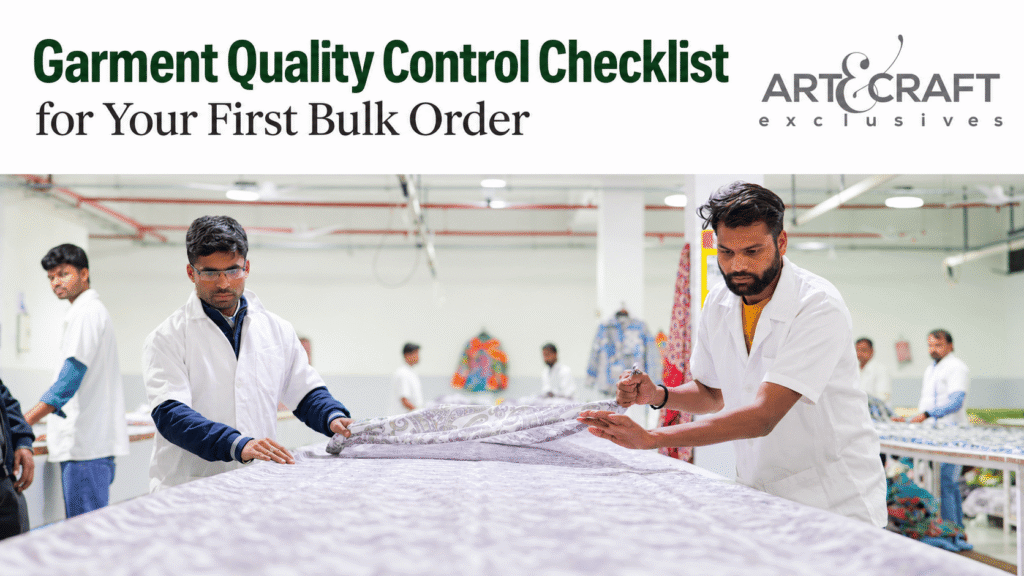
Ask for garments from identifiable bundles while the work is still on the sewing line. Keep the approved piece beside you so you and the factory can point to the same detail.
Stitch density
Lay a ruler along a straight seam and count the stitches over one inch of relaxed fabric. Compare the count with the range you agreed for that seam. On a tightly woven cloth, closely spaced stitches can push the yarns aside and leave a ripple. Coats illustrates the cause in its guide to seam puckering.
Seam construction
Turn the garment inside out. At an underarm or pocket opening, check for skipped stitches and compare the width of cloth between the stitch line and the cut edge with the approved piece. If the cloth opens beside intact stitches, its yarns may have slipped. A laboratory can assess a woven fabric’s resistance to this movement using ISO 13936-2.
Finishing
Close the zip and look along it for ripples. Examine the collar in angled light for shiny press marks. Run a finger along the inside of an embroidered neckline. If the backing feels rough, mark the exact edge on a photograph and keep the garment so the finishing team can feel it too.
Garment measurements
Measure from the points marked on the size chart. Suppose a medium shirt should measure 54 cm across the chest when laid flat, with 1 cm allowed either way. The range is 53 to 55 cm. If you read 52.8 cm, record that figure and check other medium shirts from the bundle. The tolerance for each style comes from the buyer’s specification.
For a remote inspection, ask for a photograph that shows the size label, the zero mark on the tape and the reading at the far edge. You can then see where the factory took the measurement.
Fabric behaviour after washing
Measure a spare garment before and after the agreed wash and dry cycle. A shirt that goes from 70 cm long to 67.9 cm has lost 3% of its length. Compare the result with the limit for that style and record the wash settings and number of cycles. AATCC describes how to measure changes in garment length and width in Test Method 150.
If a dark print has a pale lining, examine the lining for transferred colour. Our fabric approval guide explains which tests address colour change and staining.
What to do when a fault repeats
Return to the striped pocket. Suppose you find the same mismatch on a second shirt. An in-line inspection gives the cutting and sewing teams time to act while they can still trace the pieces.
- Trace the cut work: Note the style, size, colour and bundle. Ask which other bundles used pockets from the same batch, including any still waiting to be sewn.
- Examine the repair: Ask the factory to reposition or replace one pocket. Check the stripe and look for needle marks where the first seam ran.
- Check the next bundle: Compare a fresh shirt with the approved one. Record who checked the correction, which bundles they cleared and when sewing can resume.
How to read the final inspection report
Agree which goods make up the lot and how to grade faults before the inspector arrives. A jammed zip can make trousers unwearable. A loose thread at the hem may only need trimming. For a continuing series of lots, the acceptance quality limit, or AQL, helps determine the sampling plan. The plan sets the sample size and the counts for accepting or rejecting the lot under ISO 2859-1.
If your purchase is a one-off, ask which plan suits an isolated lot. ISO sets out an option in ISO 2859-2. When you receive the report, check which sizes and colours the inspector examined. If the lot fails, agree how the factory will sort or repair the goods and who will inspect them again before dispatch.
Buyer questions about garment inspection
What records should I ask a new factory to show me?
Ask for a report from a comparable style with the previous buyer’s details removed. Look for a measurement, a photograph of a fault and a dated entry showing what the factory found when it checked the correction.
Does AQL 2.5 tell me how many garments in my shipment are faulty?
Only a check of every garment could give you that count. AQL 2.5 helps set the decision rule for a random sample. Read the number inspected alongside the number found faulty. The result supports a decision on the lot, as NIST’s guide to acceptance sampling explains.
At Art & Craft Exclusives in Jaipur, India, we check measurements, seam strength and embroidery as part of our garment manufacturing services. If you have a first order in mind, send our team your style drawing, fabric and size range.