
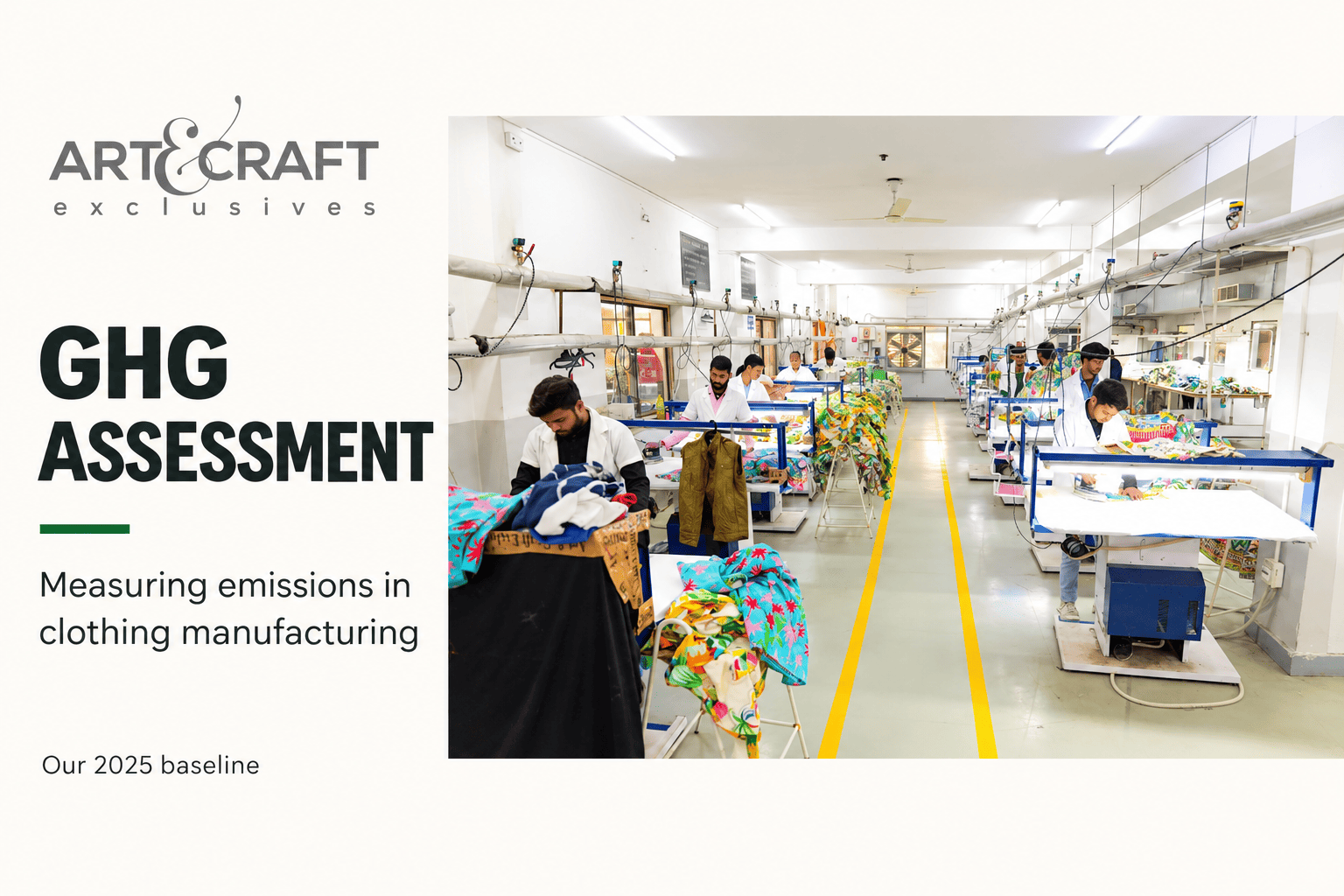
During a factory visit, you can follow a garment from the cutting table to the packing room. Machines use electricity, some processes need fuel, and vehicles carry fabric and finished orders. These activities all contribute to the emissions linked to clothing production.
A GHG assessment helps clothing manufacturers measure these emissions and identify where they can make improvements. It also gives fashion brands a clearer basis for checking the environmental information a supplier shares.
At Art & Craft Exclusives in Jaipur, we commissioned an independent assessment covering Scope 1, 2 and 3 under the GHG Protocol, using 2025 as our baseline year. Alfred H Knight provided third-party verification. This baseline helps us discuss our emissions with buyers and plan the next steps in reducing them.
What is a GHG assessment?
A greenhouse gas assessment identifies and calculates emissions from a business’s operations and relevant value chain over a defined period. It produces an emissions inventory, which records the sources, quantities, calculation methods and limits of the assessment.
Results are commonly expressed in carbon dioxide equivalents, written as CO₂e. This unit allows different greenhouse gases to be reported on a common basis using their global warming potentials. The US Environmental Protection Agency explains how these warming potentials work.
For a clothing manufacturing company in India, the assessment may cover factory fuel, purchased electricity, fabric production, transport and other relevant activities. The report should state exactly what it includes.
Why is GHG assessment needed in clothing manufacturing?
Clothing production involves emissions at several stages before a garment reaches the customer.
The UN Environment Programme’s textile value chain study identifies wet processing, including bleaching, dyeing and finishing, as an important source of climate impact. Synthetic fibre production and laundering during use also matter when those stages fall within the assessment boundary.
In its apparel emissions roadmap, World Resources Institute reported an estimated 1.025 gigatonnes of CO₂e for the sector in 2019. Material production, including knitting, weaving, dyeing and finishing, accounted for more than half of that estimate. These are historical sector figures, rather than a measurement of any individual factory.
For clothing manufacturers and their buyers, an assessment serves three practical purposes.
It supports supply chain reporting
A brand may need information from its manufacturers when calculating emissions from purchased clothing. Supplier data becomes more useful when it comes with a reporting period, clear boundaries and an explanation of how emissions were assigned to production.
The GHG Protocol Scope 3 Standard provides a framework for accounting for emissions across a company’s value chain.
It helps factories choose improvement projects
A factory can use its results to decide where further investigation or investment is needed. For example, fuel use may warrant a review of heating equipment, while purchased electricity may warrant closer examination of machinery and operating schedules.
It creates a record against which progress can be checked
A documented baseline helps a business compare later results with an earlier period. The comparison needs consistent methods and an explanation of changes in output, facilities or the production mix.
The need for an assessment may come from a buyer’s contract, a reporting programme or the manufacturer’s own plans. The accounting standard alone does not make it a legal requirement for every clothing factory.
What do Scope 1, Scope 2 and Scope 3 mean?
The three scopes group emissions according to their relationship with the reporting business.
| Scope | What it covers | Examples for a clothing manufacturer |
| Scope 1 | Direct emissions from sources the business owns or controls | Fuel burned in controlled boilers or generators, vehicle fuel and refrigerant leakage |
| Scope 2 | Indirect emissions from purchased electricity, steam, heat or cooling | Electricity bought to run stitching machines, lighting and other equipment |
| Scope 3 | Other indirect emissions across the value chain | Purchased fabric and trims, relevant outsourced transport, waste treatment and employee commuting |
The EPA’s guidance on emissions sources explains these distinctions.
The same production activity can fall under different scopes for different businesses. Fuel burned by an independently operated fabric mill is part of that mill’s direct emissions. The emissions associated with fabric purchased from it can contribute to the garment manufacturer’s Scope 3 inventory.
A report described as covering all three scopes should still identify the Scope 3 categories assessed, any exclusions and the reasons for them.
Our apparel manufacturing process guide explains the production stages where buyers can begin identifying the records and suppliers relevant to their orders.
Which standards guide the assessment?
The GHG Protocol Corporate Standard provides requirements and guidance for preparing a company-level emissions inventory.
Two related documents address specific areas:
- Scope 2 Guidance covers purchased electricity and other purchased energy.
- The Corporate Value Chain Standard covers Scope 3 emissions.
Another framework, ISO 14064-1, sets requirements for quantifying and reporting emissions and removals at organisation level. ISO 14064-3 addresses verification and validation of greenhouse gas statements.
Buyers should check which framework the actual report follows. Art & Craft’s assessment details identify the GHG Protocol as the accounting framework.
What is the process for getting a GHG assessment?
A clothing manufacturer India begins by defining the purpose and coverage of the inventory. It then gathers evidence, calculates emissions and prepares the report. Independent verification can be arranged where it is required or chosen.
The following steps describe a general assessment process:
1. Agree on the purpose and reporting boundary
Decide whether the work will cover a company, selected facilities or an individual product. Identify the intended users of the results and the accounting requirements they need.
For a company inventory, establish which entities and assets fall within the organisational boundary. The EPA’s boundary guidance describes approaches based on ownership and control.
A manufacturing group with two factories and a separate warehouse should settle their treatment before collecting figures. Any outsourced processing also needs to be identified.
2. Select the reporting period and baseline year
The reporting period defines the dates covered by the inventory. The baseline year provides the reference for tracking later changes.
Choose a period with sufficient records and document why it was selected. Set out how significant changes to the business or calculation methods will be handled when comparing future results.
A baseline identifies a starting point. Evidence from later reporting periods is needed to establish progress.
3. Collect the supporting records
Prepare a data request for each facility and relevant department. Records may include:
- Electricity bills and meter readings.
- Fuel purchases, consumption logs and stock records.
- Refrigerant servicing and replacement records.
- Fabric, trim and packaging quantities.
- Supplier information about relevant production activities.
- Freight records, shipment weights and transport distances.
- Waste quantities and treatment routes.
- Production output for any intensity calculation.
The EPA’s Inventory Management Plan guidance recommends recording data sources, collection procedures, responsibilities and quality checks.
For Scope 3, the calculation method determines the information required. Supplier-specific information, physical quantities and spending data support different methods. The GHG Protocol’s calculation guidance explains how to select methods for each category.
4. Calculate emissions using suitable factors
An emission factor expresses the emissions associated with a unit of activity.
Where a factor already includes all relevant gases in CO₂e, the basic calculation is:
Activity quantity × emission factor = emissions in CO₂e
For electricity, the activity quantity may be kilowatt-hours consumed. For fuel, it may be litres or another appropriate unit. Gas-specific calculations also require the relevant global warming potentials.
The EPA’s inventory guidance explains this calculation approach.
Factors should match the activity, geography and reporting requirements. An Indian clothing factory’s electricity calculation needs an appropriate factor for its electricity supply. The report should identify the factor source and version.
Where renewable electricity is claimed, the assessment also needs to explain the supporting evidence and its treatment under the adopted Scope 2 method.
5. Check the data and document gaps
Review units, reporting dates, missing records and duplicate entries. Compare consumption figures with the underlying evidence.
For example, fuel purchases and fuel consumed can differ when opening and closing stocks change. Shared meters may also require a documented method for dividing consumption between operations.
Keep a record of estimates and their limitations. The GHG Protocol accounting principles emphasise relevance, completeness, consistency, transparency and accuracy.
6. Arrange independent verification where appropriate
Verification reviews the greenhouse gas statement against agreed criteria. The work has its own scope, evidence requirements and assurance arrangements.
Ask the verifier to specify what will be reviewed and what the final statement will say. Resolve identified issues before finalising the report.
The Corporate Standard supports the preparation of a verifiable inventory. It does not itself prescribe the verification procedure or issue a factory certificate.
7. Report the results and plan further work
The final report should explain the totals by scope, methods, exclusions and data limitations. Any intensity measure should identify the emissions included and the output used in the calculation.
Assign responsibility for keeping the inventory current. Then use the findings to select improvement projects and track results in later reporting periods.
Assessment fees and schedules depend on the number of facilities, the coverage, the condition of the records and the verification work requested. A quotation should define these points before the work begins.
How Art & Craft Exclusives obtained its GHG assessment
At Art & Craft Exclusives, we have worked in garment manufacturing and exports from Jaipur since 1995. Our assessment adds a documented emissions baseline to the information we can discuss with buyers.
We commissioned an independent GHG assessment, selected 2025 as the baseline year and covered Scope 1, 2 and 3 within the assessment boundary. The accounting followed the GHG Protocol, and the assessment was third-party verified by Alfred H Knight.
The main details are:
| Assessment detail | Art & Craft’s reported position |
| Baseline year | 2025 |
| Accounting framework | GHG Protocol |
| Emissions coverage | Scope 1, 2 and 3 within the assessment boundary |
| Independent verification | Alfred H Knight |
| Reported intensity | 0.007 tCO₂e per piece, equivalent to 7 kg CO₂e |
Alfred H Knight India’s published services include Scope 1, 2 and 3 accounting and verification. The company’s service description explains its work. The scope of our particular engagement is established by our assessment and verification documents.
For us, the assessment provides a documented baseline, per-unit intensity data and a basis for the reduction roadmap we have committed to. Buyers can request the assessment information through our team and review its relevance to their reporting needs.
What does 7 kg CO₂e per piece mean?
The conversion is simple:
0.007 tonnes CO₂e = 7 kilograms CO₂e
The meaning depends on the calculation behind it.
A per-piece intensity relates a defined quantity of emissions to a defined production output. Buyers should check the reporting period, included activities, production denominator and any allocation method before using the result.
Our reported figure applies within the assessment scope. A product footprint for a particular dress or shirt requires evidence specific to that product and the stages being assessed.
The GHG Protocol Product Standard addresses emissions at product level. A full life cycle assessment can include raw materials, manufacturing, transport, storage, use and disposal.
Accordingly, the 7 kg figure should be read alongside our report. It does not establish a complete life cycle footprint for every style or a claim of carbon neutrality.
What should fashion buyers request from a manufacturer?
A useful review goes beyond the headline number. Request:
- Reporting period and facilities: Confirm that the assessment covers the relevant operations.
- Totals and scope breakdown: Ask for the emissions included under each scope.
- Methods and factors: Check the accounting framework and calculation sources.
- Scope 3 coverage: Review included categories, exclusions and estimates.
- Intensity calculation: Establish what “per piece” measures and how output was counted.
- Verification statement: Check its date, coverage, criteria and assurance level.
- Reduction plan: Ask which actions are proposed, completed or supported by measured results.
Use particular care when comparing manufacturers. A factory that purchases finished fabric and one that operates dyeing equipment may have different boundaries. Their product mix can also differ.
The GHG Protocol notes that its Scope 3 Standard supports tracking a company over time. Comparisons between companies need additional consistency in methods and data.
Our guide to fashion manufacturing in India covers the wider sourcing and documentation checks that belong alongside this review.
How manufacturers can use the findings to reduce emissions
The inventory should help a factory decide where to investigate and act. Suitable measures depend on its actual sources and production requirements.
Areas to review include:
- Energy efficiency: Examine heating losses, equipment efficiency and unnecessary operating hours.
- Electricity supply: Assess suitable renewable electricity options and their accounting evidence.
- Material use: Review cutting efficiency, rejected production and avoidable processing.
- Supplier processes: Discuss energy and emissions information with fabric and processing suppliers.
- Transport: Review shipment planning and the circumstances that lead to urgent freight.
WRI’s apparel roadmap identifies energy efficiency, renewable electricity and changes in materials and manufacturing heat among the sector’s reduction opportunities.
At Art & Craft, our sustainability approach includes The Green Project, which focuses on energy efficiency, unnecessary consumption and responsible resource use. The assessment gives this work a reference against which later results can be examined.
Track both total emissions and intensity. If emissions per piece fall while production grows, total emissions can still rise. Both measures help explain what has changed.
Material labels also need separate evidence. Our organic cotton and conventional cotton comparison discusses why a material description alone cannot establish the carbon footprint of a finished garment.
Discuss your carbon data requirements with Art & Craft
Tell us how you intend to use the information before applying a supplier figure to your reporting. A company inventory, an order allocation and a product footprint each need an appropriate method.
Contact our team with your collection brief and reporting requirements. We can discuss our assessment information alongside fabric sourcing, production planning and export needs.
FAQs
What is the difference between a GHG assessment and a carbon footprint?
A GHG assessment is the work of identifying and calculating emissions. A carbon footprint is the resulting measure for a defined business, product or activity. The report’s boundary explains what that footprint includes.
Is GHG assessment compulsory for every clothing manufacturer?
The requirement depends on applicable rules, reporting programmes and buyer agreements. A manufacturer can also carry out an assessment voluntarily. Following the GHG Protocol does not itself create a legal obligation for every factory.
Can a factory assess its emissions internally?
Yes. A business can prepare an inventory using suitable methods and competent staff. Independent technical support or verification may be requested by a buyer or chosen to strengthen confidence in the reported information.
Does Scope 3 include fabric bought from suppliers?
Purchased fabric can contribute to a garment manufacturer’s Scope 3 emissions. The calculation should address the relevant upstream production stages through suitable supplier data or another documented method.
Does completing an assessment make a factory carbon neutral?
No. An assessment records emissions within a boundary. A carbon-neutral claim requires separate evidence and compliance with the requirements of the claim being made.
How should a manufacturer update its inventory?
An annual inventory supports year-to-year tracking. The business should also follow its reporting programme and buyer requirements, and document significant changes in facilities, boundaries or calculation methods.
What result did Art & Craft report?
We reported 0.007 tCO₂e per piece, equivalent to 7 kg CO₂e, within our assessment scope. The assessment used 2025 as the baseline year, covered Scope 1, 2 and 3 under the GHG Protocol and was third-party verified by Alfred H Knight.
Can a brand use that figure for every garment it buys?
Its suitability depends on the intended use, assessment boundary and allocation method. A product claim needs information that supports the particular garment and production stages concerned. Discuss those requirements with our team before applying the figure.