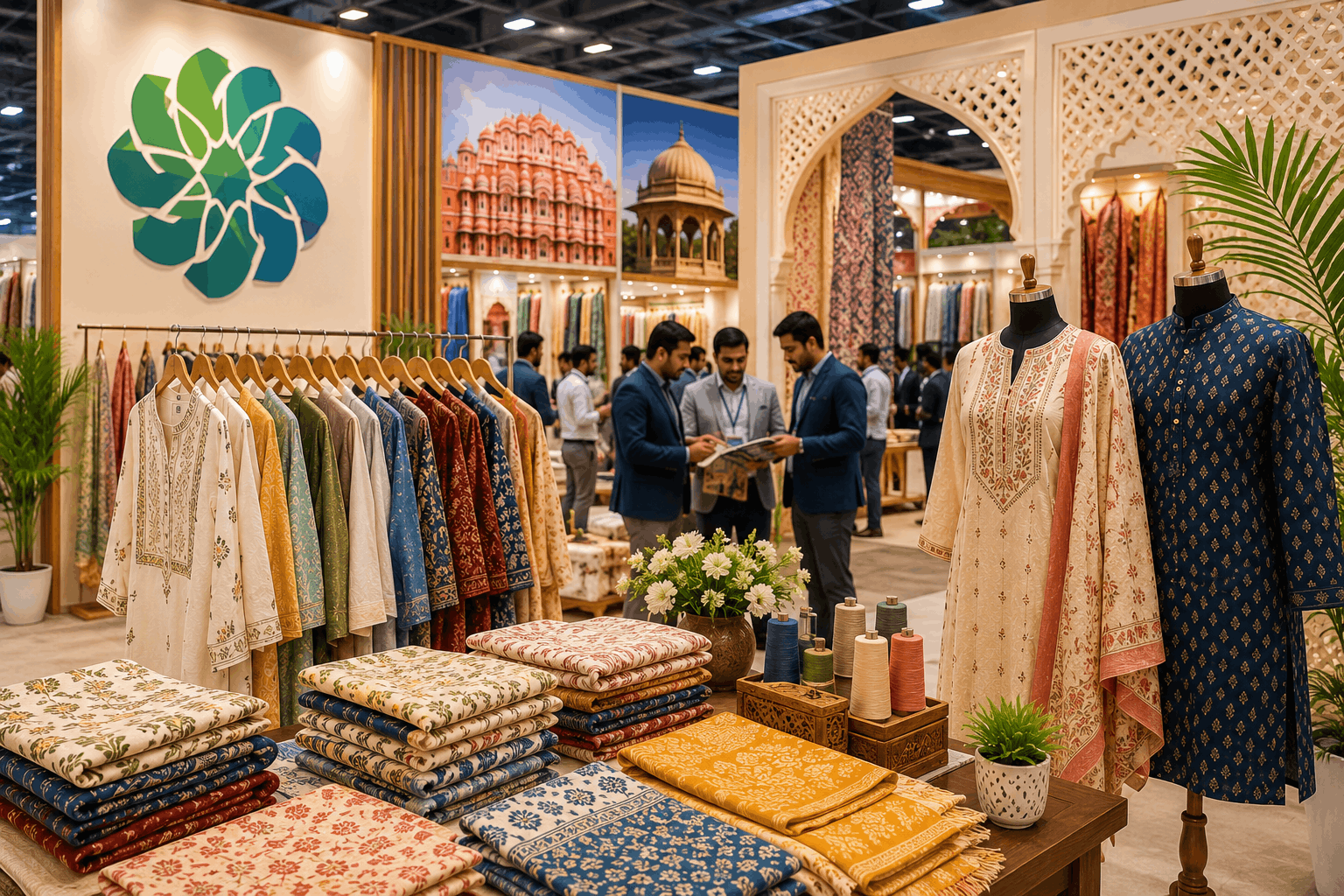
India is a major destination for apparel sourcing because buyers can access cotton garments, printed collections, embroidery, private-label production, and export support through one broad manufacturing base. For businesses visiting Bharat Tex 2026, the Jaipur and Rajasthan Pavilion can be a useful place to meet suppliers with experience in printed apparel, handcrafted details, women’s wear, resort wear, children’s wear, and customised collections. Bharat Tex will run from 14 to 17 July 2026 at Bharat Mandapam, New Delhi.
Why Visit Rajasthan Suppliers?
Jaipur and Rajasthan have a long connection with block printing, dyeing, embroidery, handwork, and craft-based textiles. These strengths can help buyers build garment collections with a distinct surface treatment, print style, or handmade detail.
The region includes suppliers working across women’s clothing, men’s wear, children’s garments, accessories, home textiles, and made-to-order collections. But, buyers should assess each supplier on product capability and export readiness rather than selecting a company only because it is based in a known textile region.
The pavilion gives buyers an efficient way to compare product ranges, fabric choices, workmanship, pricing structure, and communication standards. It can also help businesses identify which clothing manufacturers are suitable for sampling, small collections, repeat programmes, or larger production orders.
Prepare Before You Visit
A productive supplier meeting starts with a clear buying brief. Prepare your requirements before arriving at Bharat Tex so that manufacturers can give realistic answers.
Your brief should include:
1. Product category, such as dresses, shirts, kaftans, co-ord sets, jackets, or children’s garments
2. Fabric composition, weight, construction, and preferred sourcing options
3. Size range, measurements, fit requirements, and grading needs
4. Design references, artwork, print placement, embroidery, trims, and wash effects
5. Expected quantity by style, colour, and size
6. Labels, hangtags, polybags, cartons, barcodes, and other packing needs
7. Target shipment date and destination market
A detailed brief gives suppliers a fair basis for quotation. It also reduces the risk of comparing prices for garments made from different fabrics or with different finishing standards.
Check Actual Production Capability
A well-designed display does not always show the supplier’s regular production capacity. Ask each company what it makes frequently, which processes it handles itself, and which stages it sends to outside units.
For example, a supplier may be capable of cutting and stitching but may use external printing, washing, embroidery, or packing partners. This can work well when the supplier maintains control over quality and delivery, but buyers should understand the full production chain.
Ask to see finished samples from recent orders. Check fabric quality, stitching, seam strength, print accuracy, embroidery finish, measurements, and garment appearance after washing.
Good clothing manufacturers should explain their process in simple terms and provide specific information about their machinery, production team, sample room, and quality checks.
Review Quality Controls
Quality is a shared responsibility between the buyer and supplier. The buyer must provide clear specifications, while the manufacturer must follow them consistently through sampling and bulk production.
During meetings, ask suppliers how they inspect garments at key stages. A sensible system usually includes fabric inspection, measurement checks during stitching, in-line quality checks, final inspection, and packing inspection.
Request information about:
1. Fabric shrinkage and colour-fastness testing
2. Measurement tolerance for each garment size
3. Needle and metal detection where required
4. Inspection reports and defect-control methods
5. Third-party testing options for your export market
6. Procedures for replacing rejected pieces before dispatch
Many clothing manufacturers in India have experience with international buyers, but the compliance rules differ across markets. Businesses selling in the United States, the United Kingdom, the European Union, or Australia should provide country-specific labelling and safety requirements before production begins.
Confirm Capacity, Quantity, and Timing
The right supplier must be able to complete your order within the agreed schedule. Ask about monthly capacity, current booking levels, lead time for fabric, sample turnaround time, and bulk production time after approval.
Do not accept broad promises such as “delivery will be on time.” Request an estimated production calendar with key milestones. It should cover fabric booking, lab-dip approval, sample approval, cutting, stitching, final inspection, packing, and dispatch.
A company involved in garment manufacturing may be strong at high-volume basics, while another may suit lower-volume, design-led collections. Match your order type to the supplier’s actual strengths.
Also clarify the minimum order quantity by style, colour, and fabric. A low total quantity may still be difficult if it is divided across many colours or sizes.
Assess Export Readiness
A garment exporter needs more than a production floor. It also needs a working knowledge of commercial invoices, packing lists, shipping marks, certificates of origin, buyer labels, and export packing standards.
Ask who manages export documentation, whether the supplier has shipped to your market before, and which ports it commonly uses. Confirm the agreed Incoterm, payment terms, inspection point, and responsibility for freight booking.
Buyers should also request references or examples of comparable export work where appropriate. This helps establish whether the supplier understands the standards expected for your product category and selling channel.
Why Choose Art & Craft?
At Art & Craft, we support businesses looking for an experienced Jaipur partner for garment sourcing and production. Our team works with buyers from the early product brief through sampling, bulk production coordination, quality review, packing, and export preparation.
Art & Craft Exclusives is a Jaipur-based certified two-star export house with more than 30 years of experience in textiles and garment exports. This experience helps us understand the importance of clear specifications, practical timelines, approved samples, and regular communication.
As a cloth manufacturing company, we work carefully with fabric selections, print development, sizing, trims, branding details, and packing requirements. We aim to give buyers a clear view of what is possible before bulk production starts.
Businesses searching for wholesale clothing manufacturers need a supplier that can balance design requirements with repeat-order consistency. We help buyers develop collections that suit their brand, target customer, order volume, and delivery plan.
Ask the Right Questions
Use Bharat Tex meetings to collect facts, not only catalogues. The following questions can help you identify a suitable supplier:
1. Which garment categories do you produce most?
2. What processes do you manage in-house?
3. Can you make a sample from our technical pack?
4. What is your minimum order quantity by style and colour?
5. How do you inspect fabric and finished garments?
6. What is your usual lead time after sample approval?
7. Which export markets do you serve?
8. Who will manage our order after confirmation?
A textile company in Jaipur can offer strong printing and craft-based production options. Still, choose your manufacturing partner only after it meets your requirements for quality, cost, documentation, capacity, and delivery.
Conclusion
Bharat Tex 2026 offers buyers a practical setting to meet garment suppliers from Jaipur and Rajasthan, inspect products, and compare production capabilities in person. Prepare a clear brief, check physical samples, ask about quality systems, and confirm every commercial point in writing. A supplier that understands your product and communicates clearly can become a reliable partner for future collections.
FAQs
Q1. When is Bharat Tex 2026?
Bharat Tex 2026 will take place from 14 to 17 July 2026 at Bharat Mandapam in New Delhi.
Q2. What garments can buyers source from Jaipur and Rajasthan?
Buyers can explore women’s wear, men’s wear, children’s garments, resort wear, printed apparel, embroidered products, loungewear, and private-label collections.
Q3. How do I choose a garment manufacturer at Bharat Tex?
Check the supplier’s product specialisation, sample quality, production capacity, quality-control process, export experience, minimum order quantity, and delivery timeline before placing an order.
Q4. Should buyers request a sample before bulk production?
Yes. An approved pre-production sample gives both buyer and supplier a clear reference for fabric, colour, fit, trims, workmanship, labels, and packing.
Q5. Why is India a suitable country for garment sourcing?
India has an established apparel supply base, skilled production teams, broad fabric availability, and export experience, making it ideal for garment sourcing.