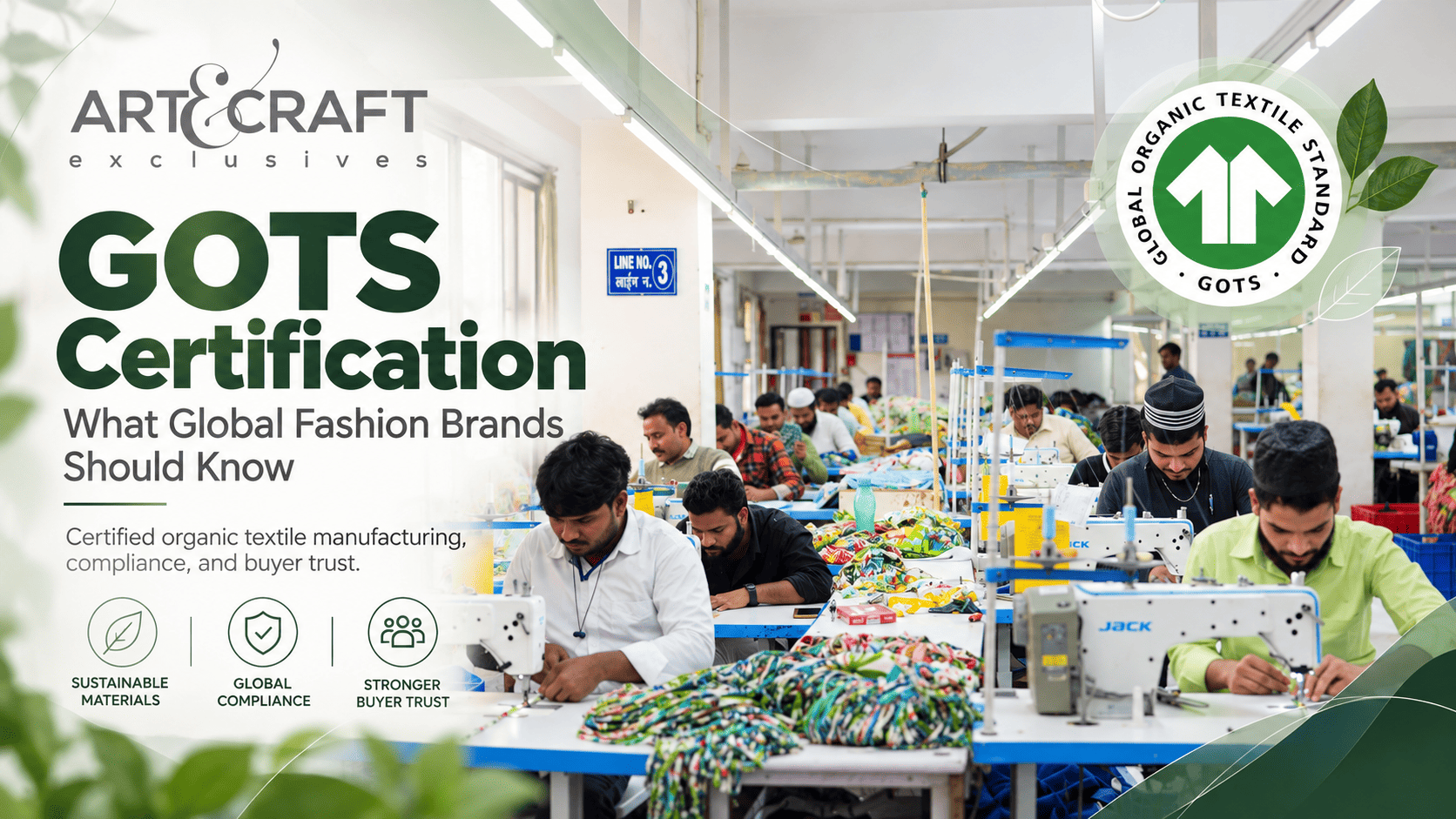
A fashion brand is developing an organic cotton collection. The designs are ready, the fabric feels right, and the manufacturer has submitted a competitive quotation. Before approving production, the sourcing manager asks one important question.
“Can you provide valid GOTS certification and the documents for our finished garments?”
This question has become increasingly relevant in international apparel sourcing.
Brands want to know where their organic fibres come from, how the fabric is processed, which chemicals are used, and whether the people manufacturing their products work under acceptable conditions.
For manufacturers, answering these questions requires proper records and independently verified systems.
The Global Organic Textile Standard (GOTS) provides a recognised framework for this work. It helps businesses verify organic textile processing and manufacturing through environmental, social, and traceability requirements.
At Art & Craft Exclusives, we recently achieved GOTS certification, an important development in our work as an apparel manufacturer and exporter from Jaipur, India.
This guide explains what GOTS certification covers, how audits work, why international buyers increasingly ask about it, and what fashion brands should verify before placing an order.
What Is GOTS Certification?
GOTS stands for Global Organic Textile Standard. It is an internationally recognised standard for textiles made with certified organic fibres.
GOTS covers the relevant processing and manufacturing stages after organic fibre production. Its requirements apply to activities such as spinning, weaving, knitting, dyeing, printing, finishing, garment production, and trading.
The standard addresses several areas:
- Certified organic fibre content and traceability
- Restrictions on chemical inputs
- Environmental management and wastewater treatment
- Occupational health, safety, and working conditions
- Human rights and due diligence requirements
- Independent inspections and certification records
The official Global Standards website explains that GOTS uses independent certification and regular audits to verify compliance across the textile supply chain.
For buyers, certification provides a defined set of requirements against which suppliers and production processes can be assessed.
What Percentage of Organic Fibres Does GOTS Require?
GOTS establishes two main labelling grades.
| GOTS label grade | Minimum certified organic fibre content |
| Organic | 95% |
| Made with organic materials | 70% |
These percentages are based on the product’s fibre composition, excluding accessories. Any additional fibres must meet the restrictions of the applicable standard.
A garment containing 70% organic fibres does not automatically qualify for GOTS certification. The remaining materials, processing stages, documentation, and other requirements must also comply.
Brands should also remember that GOTS certifies textile processing and manufacturing activities. The organic status of the original fibres must be established through a recognised organic agricultural certification system.
What Does a GOTS Audit Cover?
A GOTS audit examines whether a certified business follows the requirements that apply to its operations.
Independent, approved certification bodies conduct inspections and examine documents, facilities, production processes, and management systems.
The GOTS system requires annual on-site audits of certified facilities. Additional inspections and verification measures may also apply.
For international sourcing teams, understanding these checks helps explain what sits behind a supplier’s certificate.
1. Organic Fibre Sourcing and Traceability
An auditor checks how a manufacturer receives, identifies, stores, and uses certified organic materials.
The assessment includes records that connect purchased materials with their stated organic status.
Relevant checks may include:
- Supplier certification documents
- Incoming material and purchase records
- Storage and identification of organic materials
- Separation of certified and conventional materials
- Material consumption and production quantities
- Transaction documentation and stock reconciliation
For example, a factory producing organic cotton dresses must maintain records that support the organic material used in the certified production order.
Clear identification and physical separation help prevent certified fibres from being mixed with unsuitable materials.
2. Chemical Management and Processing
Textile manufacturing may involve dyes, inks, auxiliaries, cleaning products, and finishing chemicals.
GOTS sets restrictions on chemical inputs used in certified production and requires relevant inputs to meet its approval criteria.
During an audit, the certification body may examine chemical inventories, product information, approvals, storage arrangements, and processing records.
This is important for brands sourcing printed garments, embroidered clothing, and fabric products that involve several manufacturing stages.
A statement that a fabric uses natural fibres does not establish whether its processing chemicals meet GOTS requirements.
3. Water, Waste, and Environmental Management
GOTS also includes requirements concerning environmental controls at relevant processing facilities.
These cover matters such as wastewater, waste handling, resource monitoring, and responsible processing.
A dyeing or printing unit may face different requirements from a garment factory that primarily performs cutting, stitching, and finishing.
For buyers, the important question is which environmental activities fall within the certified facility’s scope and how compliance is assessed.
GOTS certification does not provide a universal figure for water savings or carbon emissions. Such claims need separate measurements and appropriate supporting evidence.
Our article on GHG assessment in clothing manufacturing explains how manufacturing emissions are measured and why a defined reporting boundary matters.
4. Worker Safety and Social Requirements
GOTS includes social criteria based on recognised international labour and human rights principles.
Auditors examine relevant policies, workplace conditions, records, and management practices.
The requirements address areas such as:
- Occupational health and safety
- Working hours and wages
- Prevention of child labour and forced labour
- Non-discrimination and fair treatment
- Freedom of association
- Grievance procedures and worker protections
These checks are particularly relevant to global fashion brands that evaluate suppliers against responsible sourcing requirements.
Independent certification provides an assessment against the applicable criteria. Buyers should still review the certification scope and any additional requirements specific to their company.
5. Product Quality and Compliance
A certified garment must meet the relevant GOTS product requirements.
Depending on the product and processes involved, these may include limits on certain chemical residues and checks relating to textile performance.
Certification does not replace the buyer’s own quality requirements.
A fashion brand should continue to assess fabric strength, shrinkage, colour fastness, measurement accuracy, stitching quality, and fit against the approved product specification.
At Art & Craft Exclusives, our production process includes fabric inspection, in-process quality monitoring, and final quality checks.
Why Are Buyers in Germany, the UK, and Australia Asking for GOTS?
Different markets have different legal requirements, consumer expectations, and sourcing practices.
GOTS gives brands a recognised standard to refer to when developing organic textile collections.
Its value is particularly relevant when buyers must support environmental claims with reliable evidence.
Germany: Recognition of Independent Textile Certification
Germany has a well-established market for textiles carrying environmental and social labels.
The German Federal Environment Agency, Umweltbundesamt, advises consumers to consider independent textile labels and specifically identifies GOTS among the recommended certifications.
In its published market data, the agency reports that textiles and clothing carrying social or environmental labels accounted for approximately 2.2% of the German market in 2024.
The figure shows that certified products remain a defined segment of the wider market.
For German fashion brands, working with a GOTS certified garment manufacturer can support the development of organic collections with independently verified processing requirements.
Buyers should still confirm product specifications, supplier certification, and the documents required for individual orders.
United Kingdom: Greater Scrutiny of Environmental Claims
In the United Kingdom, the Competition and Markets Authority (CMA) provides guidance on environmental claims through its Green Claims Code.
The guidance explains that environmental claims should be truthful, accurate, clear, and supported by suitable evidence.
In January 2026, the CMA published additional guidance covering environmental claims across supply chains, including the responsibilities of retailers, brands, manufacturers, and suppliers.
For clothing businesses, this means claims about organic materials and responsible production need careful supporting documentation.
GOTS can provide useful evidence for claims that fall within its certified scope.
But, GOTS certification alone does not prove every possible environmental statement about a finished garment.
Brands remain responsible for ensuring their product descriptions and marketing claims are accurate.
Australia: Evidence for Sustainability Claims
Australia’s Competition and Consumer Commission (ACCC) also emphasises the importance of accurate environmental claims.
Its guidance explains that businesses must avoid misleading representations and should have reasonable evidence for claims about environmental performance.
This applies to information presented through advertising, packaging, labels, and product descriptions.
For Australian fashion brands sourcing from India, recognised certification can help establish a clearer basis for claims about certified organic textile production.
Importers should request the correct documents and confirm the exact products covered before making claims to customers.
Is GOTS Mandatory for Exporting Clothing to These Countries?
GOTS is a voluntary certification standard. It is not a general legal requirement for every garment exported to Germany, the UK, or Australia.
A particular retailer, fashion brand, or sourcing contract may require GOTS for an organic product range.
Businesses must distinguish those buyer requirements from the laws applicable to products sold in each destination market.
For exporters, the best approach is to confirm certification and labelling requirements during product development, before fabric purchasing or bulk production begins.
GOTS Certified Manufacturer vs GOTS Certified Product: What Is the Difference?
This is one of the most important distinctions for fashion buyers.
A manufacturer may hold a valid GOTS Scope Certificate covering specified operations and product categories.
That certificate does not automatically make every garment manufactured at the facility GOTS certified.
For a finished product to be sold or labelled as GOTS certified, the relevant supply chain and production must meet the standard’s requirements.
The product must also satisfy the applicable certification and labelling procedures.
Consider a factory that manufactures both conventional cotton shirts and certified organic cotton shirts.
The factory may be certified for certain activities, while only eligible and properly documented production orders qualify as GOTS goods.
Brands should therefore verify certification at two levels.
Supplier level: Confirm the manufacturer’s current certification status and covered operations.
Product level: Confirm the certification and transaction evidence applicable to the particular order.
The official GOTS Certified Suppliers Database provides a way to check supplier information.
Understanding Scope Certificates and Transaction Certificates
International buyers frequently request two types of GOTS documents.
Scope Certificate
A Scope Certificate identifies the certified business and the approved activities or product categories within its certification.
Buyers should check the company name, facility details, certification body, validity, and stated scope.
The scope should be relevant to the work being performed for the order.
Transaction Certificate
A Transaction Certificate supports the verification of certified goods moving through the supply chain.
It connects a defined certified transaction with relevant product, quantity, and supplier information.
For brands placing bulk orders, transaction records help establish whether the certified material flow supports the finished goods being purchased.
A Scope Certificate and a Transaction Certificate serve different purposes. Buyers should confirm both according to the transaction and the applicable certification requirements.
GOTS vs Organic Cotton vs OCS: What Should Buyers Choose?
These terms are often used together, but they describe different things.
| Term | What it addresses |
| Organic cotton | Cotton grown under recognised organic farming standards |
| Organic Content Standard (OCS) | Verification of certified organic material content and chain of custody |
| Global Organic Textile Standard (GOTS) | Organic fibres, applicable textile processing, manufacturing, environmental and social requirements, and traceability |
OCS is useful when a brand needs independent verification of organic material content.
GOTS is more suitable when the sourcing requirement also includes its environmental, chemical, social, and processing criteria.
The correct choice depends on the product and the standard required by the buyer.
Our detailed comparison of organic cotton vs conventional cotton explains the material sourcing questions that fashion brands should consider before approving a collection.
Art & Craft Exclusives: Our GOTS Certification and Manufacturing Approach
At Art & Craft Exclusives, we have worked in apparel manufacturing and exports from Jaipur since 1995.
Our services include fabric sourcing, product development, sampling, printing, embroidery, garment production, quality control, finishing, packing, and export coordination.
We work across women’s wear, men’s wear, kidswear, and selected home textile categories.
We recently received GOTS certification as part of our continuing work towards more accountable manufacturing.
For us, certification supports a more structured way to demonstrate compliance with defined requirements and provide information that international buyers can review.
Why This Matters to Our Buyers
Fashion brands need to coordinate material selection, garment development, production schedules, product quality, and shipment documentation.
When organic textile certification is part of the order, these requirements must be considered early.
At Art & Craft, we encourage buyers to share their certification expectations at the initial development stage.
This helps our team review suitable sourcing options and determine what documentation and production arrangements will be required.
Our certification status must always be understood according to the current Scope Certificate. Buyers should confirm that the activities and products relevant to their order fall within the applicable certified scope.
Responsible Manufacturing Beyond Certification
We also work on wider environmental and operational improvements.
Our sustainability initiatives include the use of solar power, resource management measures, and material recovery activities.
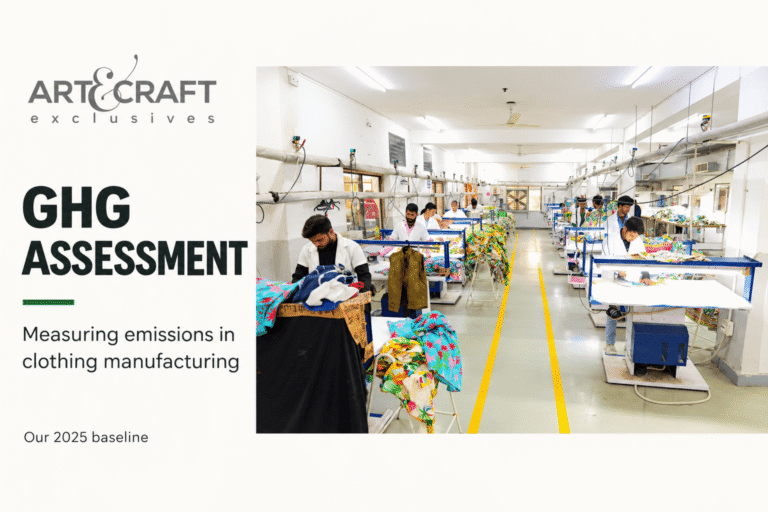
We have also completed an independent greenhouse gas assessment using the GHG Protocol, with 2025 as the baseline year and third-party verification by Alfred H Knight.
The assessment covers Scope 1, 2, and 3 within its defined boundary and provides documented emissions information for our manufacturing operations.
This work is separate from GOTS certification. Each provides evidence for different aspects of manufacturing performance.
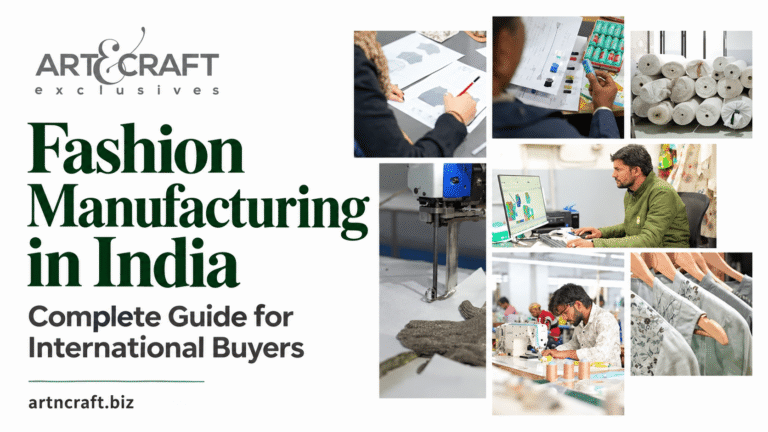
For buyers looking at broader supplier capabilities, our guide to fashion manufacturing in India explains the production, quality, and export considerations involved in choosing an Indian apparel partner.
What Global Brands Should Check Before Placing a GOTS Order
When sourcing certified organic garments, buyers should address certification requirements before approving fabric or confirming bulk quantities.
We recommend the following checks:
- Confirm the required label grade. State the certified organic fibre percentage and intended product claim.
- Review supplier certification. Check the manufacturer’s Scope Certificate, validity, and applicable production activities.
- Verify fabric sourcing. Identify the fabric supplier and confirm relevant organic material and transaction documentation.
- Discuss printing and finishing. Ensure planned dyes, chemicals, and processing methods can comply with the required standard.
- Confirm subcontracted processes. Check whether any outsourced production stages require separate certification.
- Agree on product testing. Specify the buyer’s expectations for shrinkage, colour fastness, fit, and garment performance.
- Plan documentation before shipment. Establish who will provide the required certificates and supporting records.
- Approve product claims and labelling. Confirm the correct GOTS information and obtain the necessary certification body approval before using the label.
These steps can help reduce documentation problems and production changes close to shipment.
A Practical Example for Organic Cotton Apparel Sourcing
Consider a European brand planning an order of 5,000 organic cotton dresses.
The buyer approves the fabric quality and garment design. But, the intended retail label also requires GOTS certification.
Before production begins, the brand should confirm whether the selected fabric supplier, processing facilities, garment manufacturer, and relevant trading activities meet the certification requirements.
The buyer should also confirm the permitted trims, printing process, proposed label, and transaction documentation.
Completing these checks during development allows certification requirements to become part of the production plan rather than an unresolved issue at the shipping stage.
What’s New in GOTS Version 8.1 for 2026 and 2027?
GOTS released Version 8.0 in March 2026 and followed it with Version 8.1 in June 2026.
According to Global Standards, Version 8.1 includes clarifications and corrections while maintaining the implementation deadline of 1 March 2027.
Audits and assessments conducted on or after that date must follow Version 8.1.
The updated standard addresses areas including environmental management, social requirements, due diligence, chemical controls, product compliance, and circularity.
It also clarifies the conditions under which products can be represented or advertised as GOTS goods.
For sourcing teams planning their 2027 collections, this is a useful reminder to confirm which version of the standard applies to upcoming audits and production.
Choosing a GOTS Certified Garment Manufacturer in India
India has an established textile and apparel manufacturing industry with capabilities across fibre processing, fabric production, printing, embroidery, and garment assembly.
For international brands, this provides a range of sourcing options.
But, choosing a GOTS certified garment manufacturer in India requires more than checking whether the supplier holds a certificate.
The buyer should also evaluate manufacturing capabilities, product quality, communication, capacity, delivery planning, and experience handling export orders.
For an organic cotton collection, certification requirements should be assessed alongside the garment’s design and performance needs.
At Art & Craft Exclusives, we support international buyers with product development, manufacturing coordination, and export preparation from Jaipur.
Our experience across product categories allows us to discuss fabric specifications, sampling, manufacturing methods, and buyer requirements from the beginning of a project.
We encourage buyers to confirm the current certification documentation and applicable scope before placing a certified order.
FAQs
1. What is the main purpose of GOTS certification?
GOTS provides requirements for producing textiles made with certified organic fibres. It covers applicable processing stages, chemical inputs, environmental management, social conditions, and traceability. Independent certification bodies assess compliance.
2. What does a GOTS factory audit check?
A GOTS audit examines the facility’s relevant operations and records. Checks can include organic material traceability, chemical management, environmental controls, worker safety, labour requirements, and certification documentation. The exact audit activities depend on the facility’s scope.
3. Is GOTS certification required for exporting clothes to Germany, the UK, or Australia?
No. GOTS is a voluntary standard and is not mandatory for every clothing export to these countries. Individual buyers may require it for certain organic textile collections. Applicable national product and consumer laws must still be followed.
4. Does a GOTS certified factory produce only organic clothing?
Not necessarily. A certified factory may also manufacture conventional products, subject to applicable controls. Only goods that meet GOTS requirements and have the necessary documentation can be represented as GOTS certified.
5. What is the difference between GOTS and organic cotton certification?
Organic cotton certification addresses how the cotton is grown. GOTS addresses the subsequent textile processing and manufacturing supply chain, together with environmental, social, chemical, and traceability requirements.
6. How can a fashion brand verify a GOTS certified supplier?
Brands can check the current Scope Certificate, confirm the facility and approved activities, and consult the official GOTS supplier database. For specific orders, buyers should also review the applicable transaction and product certification records.
7. Does GOTS certification guarantee lower carbon emissions?
No. GOTS includes environmental management requirements, but it does not provide a universal carbon footprint for every certified garment. Product or company emissions claims need appropriate measurements and supporting evidence.
8. What is the latest GOTS standard in 2026?
GOTS Version 8.1 is the latest published version as of October 2026. Its mandatory implementation date is 1 March 2027. Certified businesses should discuss the transition requirements with their approved certification body.
Work With Art & Craft Exclusives for Your Next Collection
For fashion brands developing organic cotton collections, certification requirements should be considered alongside design, fabric performance, product quality, and delivery planning.
At Art & Craft Exclusives, our GOTS certification marks an important step in strengthening the systems and documentation that support our manufacturing operations.
We welcome discussions with international buyers who want to understand our capabilities, relevant certification scope, material sourcing options, and production arrangements.
If you are planning your next collection, share your product brief, fabric requirements, order quantities, destination market, and certification needs.