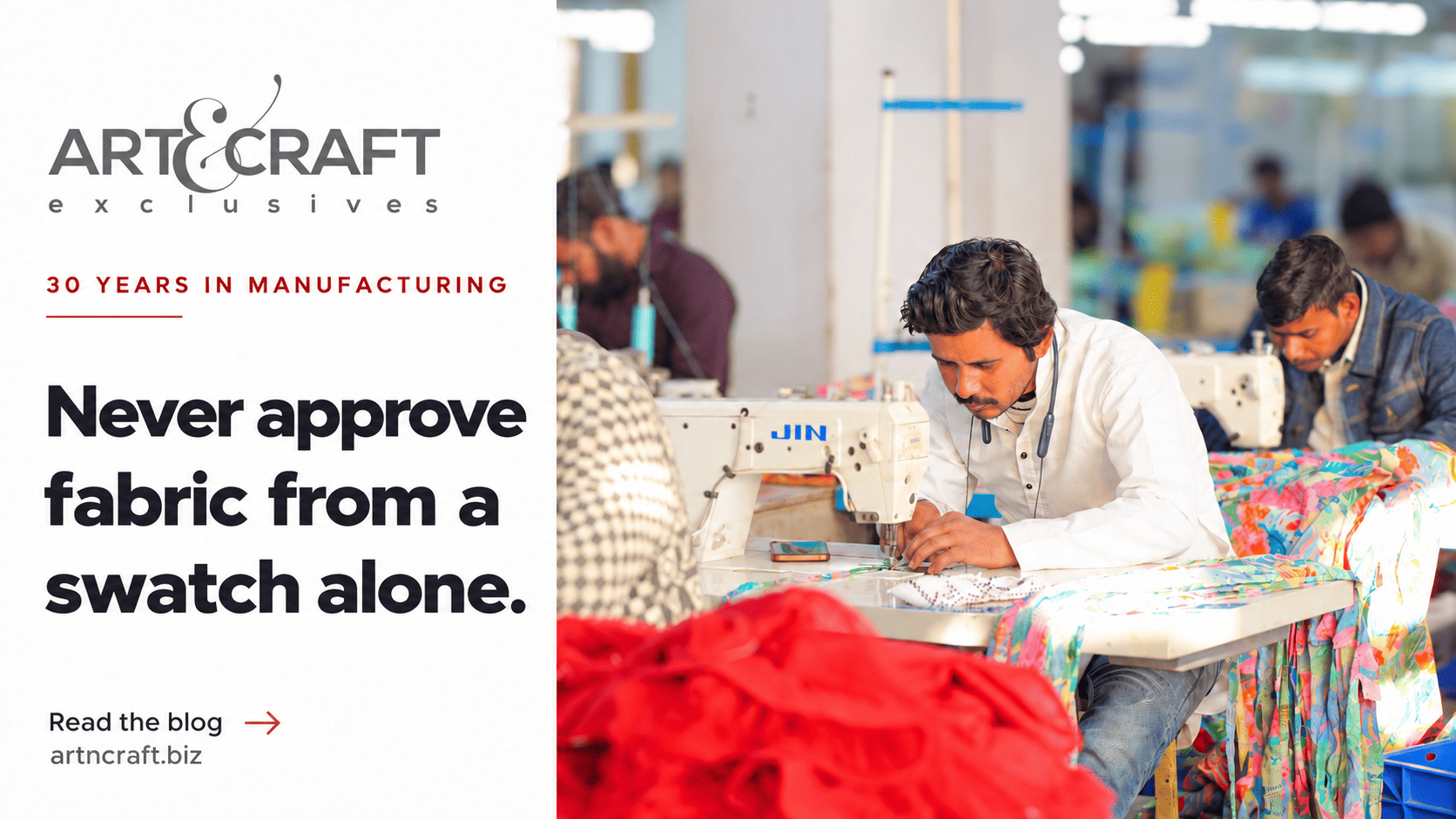
Lessons from 30 years of garment manufacturing
A fabric swatch can look right for a collection. The colour suits the design, the surface feels soft, and the price fits the budget. Yet the buyer still has several questions to answer before placing a bulk order. How will the fabric behave after washing? Will it support the planned seams and embroidery? Will the delivered rolls match the sample?
At Art & Craft Exclusives, more than 30 years in garment manufacturing have taught us to look at fabric through the work it must perform. A material needs to suit the design, pass through production and meet the customer’s expectations during use.
Our advice to brands, importers and sourcing teams is simple. Use the swatch to shortlist a fabric. Complete the fabric approval process with clear specifications, suitable tests, garment samples and checks on the actual production material.
Why a fabric swatch cannot confirm production quality
A swatch shows the appearance and feel of one small piece of fabric. Looking at and handling it cannot establish wash performance, seam behaviour or consistency across a bulk order. Approval for production needs evidence from representative material and the intended garment construction.
This distinction matters when a buying team sends a brief message such as “fabric approved”. The mill may understand that message as permission to produce the fabric. The garment factory may read it as permission to cut.
State what each approval covers. A decision on colour, texture or design direction should identify the checks that remain open.
Start with a fabric specification that the mill can follow
Descriptions such as “soft cotton” or “lightweight viscose” help explain a design idea. A mill needs measurable details to reproduce that idea consistently.
Record the following in the fabric specification sheet:
- Fibre composition and blend percentages.
- Woven or knitted construction, with the relevant yarn and density details.
- Fabric weight in grams per square metre, usually called GSM.
- Usable width for cutting, with the agreed tolerance.
- Colour reference, print artwork and repeat size.
- Required finish and intended care instructions.
- Test methods, acceptance limits and approval responsibilities.
GSM describes weight per unit area. Two fabrics with the same GSM can still use different yarns, structures and finishes. Treat equal weight as one point of comparison.
CottonWorks guidance on quality testing explains how yarn properties and fabric construction affect performance and cost. This is why a fabric sourcing decision needs more detail than fibre name and weight.
Keep the specification beside the reference swatch. The written details should explain what the supplier must reproduce.
Check how washing changes the fabric and the garment
A swatch at room temperature gives no reliable measure of how a finished garment will change during washing and drying.
CottonWorks explains that fabric construction and the forces applied during dyeing and finishing affect shrinkage. Sewing and garment finishing can also influence the result.
For washable products, agree on the washing procedure, drying method and number of cycles before testing. Measure changes in both length and width. Inspect the sample for twisting and changes in appearance as well.
The American Association of Textile Chemists and Colorists provides separate methods for these stages. AATCC TM135 measures dimensional changes in fabrics after home laundering. AATCC TM150 covers garments, with limitations for certain stretch fabrics. Ask the laboratory to confirm which method suits the product.
Consider a simple illustration. If a 70 cm garment length shrinks by 4%, it loses 2.8 cm. This calculation shows why a small percentage can matter to fit. It does not predict how a particular fabric will behave.
Agree on acceptable shrinkage for the actual product. A loose dress and a close-fitting woven shirt may need different limits. Keep the approved care instructions consistent with the conditions used to assess performance.
Assess colour after washing and rubbing
Colour approval and colourfastness answer different questions. One confirms the intended shade. The other assesses how the colour withstands a defined exposure.
Two useful methods illustrate this difference:
- AATCC TM61 assesses colourfastness under accelerated laundering conditions.
- AATCC TM8 assesses colour transfer through rubbing, including wet and dry procedures.
A washing result does not establish resistance to rubbing. Choose the tests that match the garment’s use, colour combinations and care instructions. A laboratory may recommend further checks for exposure to perspiration or light.
For a dark printed garment with a pale lining, ask the laboratory how to assess staining between the components. A fabric can retain an acceptable overall shade while transferred colour affects another part of the garment.
Record the method, conditions and required result. The phrase “good colourfastness” leaves too much open to interpretation.
Sew the fabric before making the final decision
Fabric approval should include a trial with the planned garment construction. Seams, interlining, trims and surface work introduce demands that a loose swatch never encounters.
Make a development sample and review the areas most likely to cause trouble:
- Seams at fitted areas or points that take strain.
- Needle marks and puckering along stitched sections.
- The weight and placement of embroidery.
- Drape, opacity and movement on the body.
- The behaviour of collars, cuffs, plackets and fused sections after the intended care process.
For woven fabrics, seam slippage deserves attention where the design places strain on the seam. This occurs when fabric yarns move apart at the sewn area. ISO 13936-2 provides a method for assessing resistance to this movement. It addresses a different question from whether the sewing thread breaks.
Use the findings to adjust the fabric, seam construction or design before approving the production sample. If the team changes the material or finishes, review the affected checks again.
Compare the approved sample with the bulk fabric
A development sample establishes a reference. The incoming bulk fabric still needs inspection.
Agree on a sampling plan that represents the relevant colours, batches and rolls. Identify which material supplied each test sample. A report for a different fabric or an unidentified earlier batch gives the buyer little evidence about the delivery in front of them.
During bulk fabric inspection, check usable width, weight, shade variation and visible defects. Review the full print repeat where relevant. Keep roll and batch details with the inspection records.
ASTM D5430 describes methods for visually inspecting and grading fabrics. It allows buyers and suppliers to use agreed procedures for accepting rolls and shipments. The standard also notes that different point assignment options can produce different results.
Agree on the grading method, inspection coverage and acceptance limits before the shipment arrives. Visual inspection covers visible defects. Arrange the performance tests that the order also requires.
Turn fabric trends into practical development questions
A new collection may call for lighter cloth, textured weaves, larger prints or a softer finish. Each choice changes what the development team needs to examine.
Our recommendation is to translate the design direction into a short trial plan.
| Fabric or design choice | What to check before approval |
| Lightweight fabric | Opacity, seam performance and whether the design needs a lining |
| Textured or loosely woven fabric | Seam slippage, snagging and stability during handling |
| Large or directional print | The complete repeat, placement on the garment and fabric use when matching panels |
| Soft or washed finish | Feel, dimensions and appearance after the intended care process |
| Embroidery on a light base fabric | Puckering, support materials and the weight of the finished embroidered area |
These checks help a brand judge whether the proposed fabric suits its product and selling price. For example, a print that requires careful matching may increase fabric use. A lightweight cloth may need a lining that changes cost and construction time.
Ask the sampling team to show those effects in the garment and costing before confirming the order.
Check the evidence behind material claims
A swatch cannot establish organic status or traceability. Those claims need records that connect the stated material to the relevant supply chain.
For a GOTS order, check the supplier’s current certification and relevant scope. The official certified suppliers database lists certified entities, their fields of operation and product categories. Confirm any missing or unclear information with the certification body, and agree on the documents required for the order.
Keep the product’s physical performance requirements in the approval plan as well. Our article on organic cotton and conventional cotton explains why sourcing evidence and fabric performance both matter when brands choose materials.
A fabric approval process buyers can use
Give each stage a clear purpose and a named person responsible for the decision.
- Define the product: Confirm the garment type, intended customer, fit, care method, destination market and price target.
- Agree on the fabric specification: Record the material details, tolerances and planned production processes.
- Review development material: Assess the swatch, colour submission or print trial. State exactly what the approval covers.
- Test and make samples: Use representative material for the agreed laboratory tests and garment trials. Close any failures before the relevant production stage.
- Verify the bulk fabric: Compare the delivery with the approved reference and specification. Review the inspection records and applicable test reports.
- Release bulk cutting in writing: Confirm the pre-production sample, approved material and outstanding actions. Keep a dated reference sample and the approval record.
The order of individual tasks may vary with the product. The key is to make each decision visible to the buying team, mill and garment factory.
Our guide to the apparel manufacturing process in India explains how material checks connect with sampling, cutting, sewing and dispatch.
What the final approval record should contain
Before bulk cutting, the responsible team should be able to find:
- The fabric code, supplier and relevant batch or roll references.
- The current specification and approved physical reference.
- The test reports and their acceptance criteria.
- The bulk inspection result.
- The approved pre-production sample and sample comments.
- The approver’s name, approval date and any agreed conditions.
If a supplier changes the yarn, construction, dyeing route or finish, ask what the change affects and which checks need repeating. A familiar fabric name should not carry an old approval into a changed material without review.
FAQs
How much fabric should a buyer request for approval?
Request enough material for the planned tests, garment samples and a retained reference. The amount depends on fabric width, garment size, print repeat, colourways and the laboratory’s specimen requirements. Confirm the quantity with the laboratory and sampling team.
Does approval of a lab dip mean the fabric is ready for production?
A lab dip is a small dyed sample used to develop and approve a colour. Its approval confirms that colour decision under the agreed viewing conditions. Keep fabric performance, bulk shade and garment approval as separate decisions in the order record.
Can two fabrics with the same composition and GSM perform differently?
Yes. Yarn properties, fabric construction and finishing can differ. Compare the full specifications, test results and garment samples before accepting one fabric as a substitute for another.
What is an acceptable fabric shrinkage percentage?
There is no single limit that suits every garment. Set the permitted dimensional change according to the product, fit, care instructions and buyer requirements. Record the test method and washing and drying conditions beside the limit.
Can photographs replace physical fabric approval?
Photographs help teams discuss appearance and placement. They cannot establish hand feel, wash behaviour or seam performance. Keep physical samples and test records for the decisions that depend on those properties.
Discuss fabric requirements before confirming your next order
The practical lesson from our years in manufacturing is to settle fabric questions while the team can still act on the answers. Once cutting begins, a change can affect material use, work already completed and the delivery plan.
Art & Craft Exclusives supports brands through fabric sourcing, product development and garment manufacturing. Share your technical pack, fabric references, intended care instructions and order requirements with our team. These details provide a useful starting point for planning the samples, checks and approvals your collection needs.